顯示具有 新.生活 標籤的文章。 顯示所有文章

2026/07/24

留下 Staying


热带的忧郁,是你以为所有发光的物体都是有温度的。月亮,以及稀疏的星子,恣意狂欢的夜。你不曾告诉我,热带的孤枕,也有取暖的渴望。

二十年前,初来新加坡的一个不眠之夜我写下了这些句子。

我的渴望,在三个月后必修课元明清文学的最后片刻,在那首真心英雄唱的把握生命里的每一分钟,全力以赴我们心中的梦。不经历风雨,怎么见彩虹,没有人能随随便便成功七十双热切的眼睛里闪着泪光,有纸条传来,写着:希望老师陪着我们毕业。得到了彷徨的回应。

我申请延长海外研修,直到期满,下定決心离开台湾。我给原来的工作单位和南洋理工大学中文系的同事们都发了电邮。邮件的题目就是:留下。我說:

凡走过的,必留下痕迹。有的人留下的是珠玑;有的人留下的是垃圾。

而我,能留下什么呢?

这是我来到新加坡以后,才意识到,并且开始认真思考的问题。

决定留在南大,我以为一个学术单位不缺专业的研究人员,而师资尚未完备的南大中文系需要我的一点力量。尤其体会到,自己正在为南洋一带的华人文化与文学培养传承者,这是我在台湾教书时从未经验过的责任感。

人生无法重来,我希望我的人生抉择不是一厢情愿。

那天是 2008 5 9 日,中文系准备从澳洲聘任新的系主任,我提出了自己的看法。511日,我特地去参拜了南洋大学的真迹牌坊,默默许愿。。

我留下,是因为相信。

相信一个刚刚成立不久的中文系,有望一起建设;相信华文教育在这个岛国,昂首迎向未来;也相信,一位教师除了研究与写作,还可以为一个文化共同体做一点事情。

如今二十年过去,我常常想,如果当年知道后来会经历的一切,我还会不会作出同样的决定?

后来,我经历过办公室政治,经历过误解与伤害;曾经为了维护自己的尊严与公义,不得不寻求法律的协助和保护。那些日子非常不好过,深深在我心底烙下阴影。

今天回头望去,我发现:当年真正留下来的理由,并不是预想一切顺心称意,而是因为所有的经历,都成为生命未知的一部分。

如果没有留下,我不会在2014年创发文图学;不会在2017年与志同道合的朋友们成立文图学会,也不会一路走到今天,让文图学从一个研究构想,逐渐成为许多学者共同参与、不断发展的学术视野。如果没有留下,我不会担任中文系主任,与同事一起规划中文系的发展。

这些年来,我最难忘的,并不是出版了多少本书,也不是获得了什么奖项,而是文物艺术导览或公众演讲结束以后总有人走过来,对我说:原来博物馆可以这样看。”“我竟然听得懂大学教授讲的话!

还有学生告诉我:我没想到会期待上您的古典文学课。

每一次听见这些话,我都庆幸,当初留下来的决定,是值得的。

我渐渐明白,一个学者真正留下来的,不一定是自己的名字,而是别人度过人生的方式。或许,这正是我二十年来最大的收获。

新加坡给予我的,不只是一个谋生的职场,而是一种观看世界的立场。

它让我站在不同文化交会之处,重新理解中国,也重新理解东亚,更重新理解自己。

人年轻的时候,总想着到哪里去。

后来才知道,更重要的是,在哪里留下什么。

二十年前,我留下,是因为有人希望我留下。

二十年后,我还在这里,还有许多值得继续努力的工作;还有许多文化值得继续传承创新;还有许多人愿意和我一起相信,人文学并没有淘汰,阅读、审美与思考,依然能够温暖这个时代。

于是,我终于明白——“留下,是在一片土地上,把自己慢慢活成一道风景;把一点点微弱的光,继续照亮前方的道路。

当年那个住进校园宿舍、望着热带夜空的异乡人,不会知道二十年后的今天,会写下这篇文章。而今天的我,只想轻轻对二十年前的自己说一句:刚刚好,你选择了留下。


——纪念2026716日,移居新加坡20年。


2026718日,新加坡《联合早报》上若水专栏。


Staying

I Lo-fen

The melancholy of the tropics lies in believing that everything that shines gives off warmth. The moon, a scattering of stars, a night reveling without restraint. You never told me that even a solitary pillow in the tropics longs for warmth.

Twenty years ago, during a sleepless night shortly after arriving in Singapore, I wrote these lines.

Three months later, in the final moments of the compulsory course “Literature of the Yuan, Ming, and Qing Dynasties,” my longing received a hesitant response. As the song “True Heroes” played—

“Seize every minute of life,
Give everything for the dream in our hearts.
Without weathering storms, how can we see the rainbow?
No one can succeed without effort…”

tears glistened in seventy pairs of eager eyes. A note was passed to me. It read: “We hope you will stay with us until we graduate.”

I applied to extend my overseas research leave to its full term and resolved to leave Taiwan. I sent emails to my former institution and to my colleagues in the Chinese Division at Nanyang Technological University. The subject line was simply: “Staying.”

I wrote:

“Wherever we have passed, we inevitably leave traces behind. Some leave pearls and gems; others leave rubbish.

What, then, can I leave behind?

It was only after coming to Singapore that I became aware of this question and began to contemplate it seriously.

In deciding to stay at NTU, I believed that an academic institution would never lack professional researchers, but the still-developing Chinese Division needed whatever strength I could offer. Above all, I came to realise that I was helping to nurture those who would carry forward Chinese culture and literature in Nanyang. This was a sense of responsibility I had never experienced while teaching in Taiwan.

Life cannot be lived again. I hope that the choice I have made is not merely wishful thinking.”

That day was 9 May 2008. The Chinese Division was preparing to appoint a new head from Australia, and I offered my views. On 11 May, I made a special visit to “pay homage” to the “authentic” archway of Nanyang University and silently made a wish.

I stayed because I believed.

I believed that a recently established Chinese Division could be built together; I believed that Chinese-language education on this island could hold its head high and embrace the future; and I believed that, beyond research and writing, a teacher could still do something for a cultural community.

Now that twenty years have passed, I often wonder: had I known then everything I would later experience, would I still have made the same decision?

In the years that followed, I experienced office politics, misunderstandings, and hurt. To defend my dignity and uphold justice, I once had no choice but to seek legal assistance and protection. Those were extremely difficult days, leaving deep shadows imprinted upon my heart.

Looking back today, I realise that the true reason I stayed was not because I expected everything to proceed smoothly and according to my wishes, but because every experience would become part of life’s unknowable unfolding.

Had I not stayed, I would not have founded Text and Image Studies in 2014. I would not have established the Text and Image Studies Society with like-minded friends in 2017, nor would I have travelled this far, allowing Text and Image Studies to grow from a research concept into an academic perspective in which many scholars now participate and which continues to develop. Had I not stayed, I would not have served as Head of the Chinese Division and worked with my colleagues to plan its future development.

What I remember most vividly from these years is not how many books I have published or what awards I have received. It is that, after a guided tour of cultural relics and art or a public lecture, someone will invariably come up to me and say, “I never knew a museum could be viewed this way,” or, “I can actually understand what a university professor is saying!”

Students have also told me, “I never imagined that I would look forward to your classical literature class.”

Every time I hear these words, I feel grateful that my decision to stay was worthwhile.

Gradually, I came to understand that what a scholar truly leaves behind is not necessarily her own name, but the way other people live their lives. Perhaps this has been my greatest gain over the past twenty years.

What Singapore has given me is not merely a workplace in which to earn a living, but a standpoint from which to view the world.

Standing at the confluence of different cultures, I have been able to understand China anew, to understand East Asia anew, and, even more importantly, to understand myself anew.

When we are young, we are always thinking about where we should go.

Only later do we realise that what matters more is what we leave behind, wherever we may be.

Twenty years ago, I stayed because someone hoped that I would stay.

Twenty years later, I am still here. There is still much worthwhile work to pursue; there are still many cultures whose traditions deserve to be carried forward and renewed; and there are still many people willing to believe with me that the humanities have not become obsolete—that reading, aesthetic appreciation, and thought can still bring warmth to this age.

And so, I finally understand: “staying” means slowly living oneself into a landscape upon a piece of land, and allowing one’s faint glimmer of light to continue illuminating the road ahead.

The stranger who moved into a campus apartment and gazed at the tropical night sky could never have known that, twenty years later, she would write this essay. Today, I only wish to say softly to the person I was twenty years ago:

“It was just right—you chose to stay.”

—In commemoration of 16 July 2026, marking twenty years since I moved to Singapore.


18 July 2026, “The Shang Shan Ruo Shui Column,” Lianhe Zaobao, Singapore.


2026/05/09

多了两首诗


学期过半,我请助教从本学期教过的诗作中选出十二首,作为其中测验的出题范围。对我来说,这是一个再平常不过的教学安排。十二首诗,不算多,也不算少,既足以让学生回顾课堂重点,又不至于造成太大的准备负担。

没想到,事情却从这里开始变得复杂起来。

有学生来反映,说我在课堂上讲过,这次测验只需要准备十首诗,而不是十二首。也有人表示,我曾经提到篇幅较长的作品不会纳入考题范围。这些话,我非常确定自己没有说过。

刚好这学期我上课有录音。于是,为了确认,也为了给助教一个明确的答复,我开始翻找课堂录音。整整找了很长一段时间,反复拖动音轨,试图在一节又一节课的内容中,找到那句可能被误听、误解,甚至根本不存在的话。

结果当然没有找到。

我没有说过十首,也没有说过长篇不会考。但这件事让我感到非常懊恼。不是因为学生记错,而是因为我发现自己竟然愿意为此投入那么多时间,只为了证明我没有说过。

那一刻,我意识到,这件事情其实早已不只是多背两首诗的问题。

从学生的角度来看,这是一项风险管理任务。十首与十二首之间的差别,不在于文学价值,而在于准备成本。多两首诗,意味着多一些不确定性,多一点可能在考场上出现却未能充分掌握的风险。所谓测验范围,不再是课程内容的整理,而是考试边界的划定。

他们关心的,不是这首诗讲了什么,而是它会不会出现在试卷上。

于是,任何关于范围的提示——即便只是语气中的模糊表达,甚至是他们自己的理解都可能被记住、放大,并在需要时成为一种可以据以协商的依据。

而我呢?

我本可以直接统一说明:本次测验范围为十二首诗,以课程网站最新公告为准。事情也许就此结束。但我却选择回到录音中去寻找证据,试图厘清到底是谁记错了。

为什么?

因为在那一瞬间,我把学生的疑问理解成了一种对我教学一致性的质疑。我担心他们会觉得我前后说法不一,担心这会影响他们对课程公平性的感受,甚至担心这会成为对我教学表现的负面评价。

于是,一项只占总成绩15%的测验安排,开始牵动更大的情绪反应。我不再是在处理一个教学细节,而是在为自己的专业性辩护。

当我终于意识到这一点时,也意识到自己其实承担了本不必承担的解释成本。

在一个高度评量导向的学习环境中,学生自然会把课程内容转化为可控的考试范围,而教师也容易将任何关于范围的争议,视为对自身教学规范性的挑战。双方都在努力降低不确定性,却也因此不断加深对规则的依赖。

文学课程于是变成了一种边界管理任务:什么会考,什么不会考;哪些需要背诵,哪些可以略过。诗不再只是诗,而是一个可能出现在考卷上的项目。

而我花时间找录音的行为,本身也成为这种环境的体现——我们越来越需要可以追溯的说明、明确的承诺,以及可供核对的记录,来维持一种被认为是公平的教学秩序。

多出来的两首诗,也许本身并不重要。重要的是,它们如何在师生之间,引发了对规则、记忆与责任的重新界定。

教学现场的日常,有时就是这样:看似微小的调整,却能让我们看见,在分数与准备之间,理解与完成之间,究竟有哪些不易察觉的张力正在发生。


202659日,新加坡《联合早报》,“上善若水”专栏


Two Additional Poems

I Lo-fen

Halfway through the semester, I asked my teaching assistant to select twelve poems from those taught in class this term as the scope for the midterm quiz. To me, this was a perfectly ordinary teaching arrangement. Twelve poems were neither too many nor too few: enough for students to review the key points covered in class, but not so many as to create an excessive burden of preparation.

Unexpectedly, things began to grow complicated from there.

Some students came to say that I had mentioned in class that only ten poems needed to be prepared for the quiz, not twelve. Others said that I had once stated that longer works would not be included in the examination scope. I was absolutely certain that I had never said any such thing.

As it happened, I had recorded my lectures this semester. So, in order to confirm the matter and to give my teaching assistant a clear answer, I began searching through the lecture recordings. I spent a long time doing so, repeatedly dragging the audio track back and forth, trying to locate, in one class session after another, the sentence that might have been misheard, misunderstood, or perhaps had never existed at all.

Of course, I found nothing.

I had never said ten poems, nor had I said that longer works would not be tested. Yet this incident left me deeply frustrated. Not because the students had remembered incorrectly, but because I realized that I had actually been willing to spend so much time on it, merely to prove that I had not said something.

At that moment, I became aware that this matter had long ceased to be simply a question of “memorizing two additional poems.”

From the students’ perspective, this was a task of “risk management.” The difference between ten and twelve poems did not lie in literary value, but in the “cost” of preparation. Two additional poems meant a little more uncertainty, a slightly greater risk that something might appear on the test that they had not fully mastered. The so-called scope of the quiz was no longer an organization of course content, but a demarcation of examination boundaries.

What they cared about was not what a poem was about, but whether it would appear on the test paper.

Thus, any hint regarding the scope—even if it was only an ambiguous expression in tone, or even their own understanding—could be remembered, magnified, and, when necessary, turned into a basis for negotiation.

And what about me?

I could have simply made a unified clarification: “The scope of this quiz consists of twelve poems, as stated in the latest announcement on the course website.” The matter might then have ended there. Yet I chose instead to return to the recordings to look for evidence, trying to determine who had remembered incorrectly.

Why?

Because in that instant, I understood the students’ question as a challenge to the consistency of my teaching. I worried that they might think I had contradicted myself. I worried that this would affect their perception of fairness in the course. I even worried that it might become a negative evaluation of my teaching performance.

As a result, the arrangement for a quiz that counted for only 15 percent of the final grade began to trigger a much larger emotional response. I was no longer handling a minor teaching detail; I was defending my professionalism.

When I finally realized this, I also realized that I had taken on an explanatory burden that I did not in fact need to bear.

In a highly assessment-oriented learning environment, students naturally transform course content into a controllable examination scope, while teachers also easily come to regard any dispute over that scope as a challenge to the normativity of their teaching. Both sides are trying to reduce uncertainty, yet in doing so they deepen their reliance on rules.

A literature course thus becomes a task of boundary management: what will be tested and what will not; what must be memorized and what can be skipped. A poem is no longer merely a poem, but an item that might appear on an examination paper.

And my act of spending time searching through the recordings itself became a manifestation of this environment—we increasingly need traceable explanations, explicit commitments, and verifiable records in order to maintain a teaching order that is regarded as fair.

Perhaps the two additional poems themselves were not important. What matters is how they prompted a redefinition, between teacher and students, of rules, memory, and responsibility.

The everyday scene of teaching is sometimes just like this: a seemingly minor adjustment can allow us to see what subtle tensions are taking place between grades and preparation, between understanding and completion.

May 9, 2026, “Shang Shan Ruo Shui” column, Lianhe Zaobao, Singapore.
 

2026/02/28

AI 都会总结了,我们是否不必看书?AI can summarize everything—do we no longer need to read books?


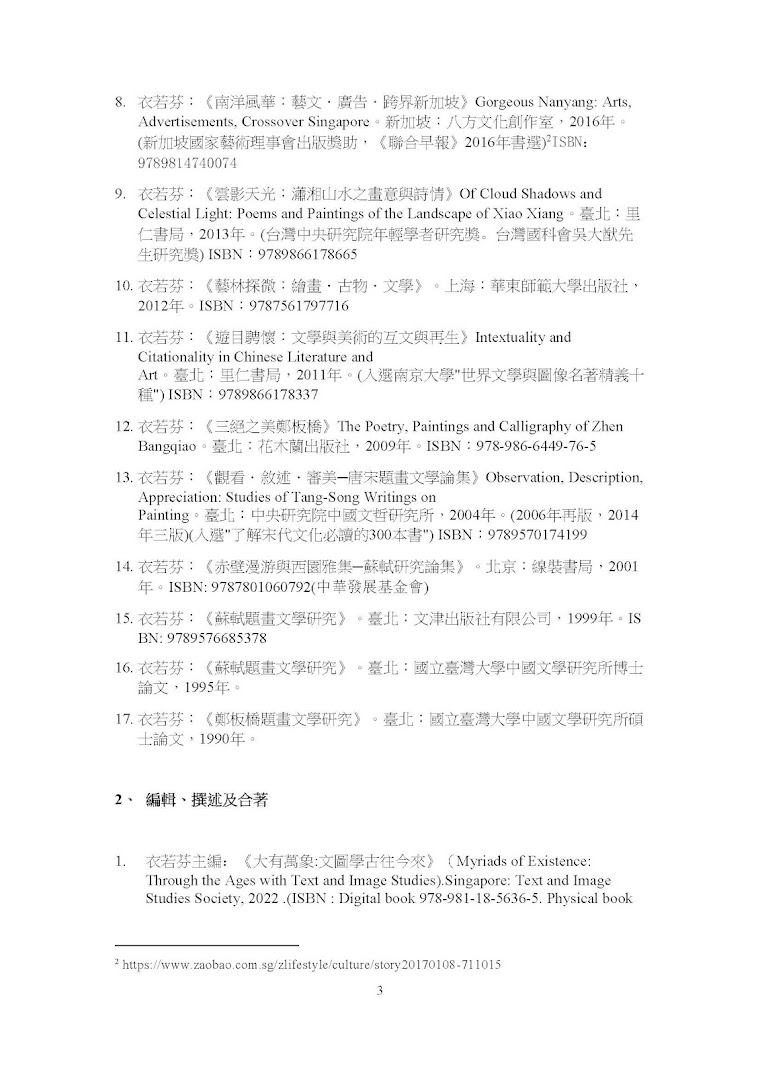
过年前整理电脑的文件夹,发现一张多年前随手拍的照片。

到今年七月,我移居新加坡整整二十年。在这不算短的岁月里,我唯一一次看到有人在地铁上看书,而且还是个小孩子。他低垂着头,完全沉浸在那本厚厚的书里,看样子可能是一本小说。我忍不住拿起手机,拍下了这难得的画面。

车厢在轨道上晃动,隆隆作响。他的右腿叠在左腿上,膝头的书似乎不容易被他小小的右手手指和掌心稳住。身后窗外透进来的光落在书面上,密密麻麻的英文字。像是被吸进了那本书的世界里,只有在翻页的时候,他的身体才稍微动了一下。

这个姿势我太熟悉了。

曾几何时,我几乎忘了在公共场所那屏蔽周遭,乐在其中的感觉。

现在网路搜索还带着 AI 模式,找一本书,AI 直接总结书的内容。比如你查《红楼梦》,AI告诉你:原名《石头记》,是中国古典四大名著之首,由清代作家曹雪芹所著。该书以贾、史、王、薛四大家族的兴衰为背景,通过贾宝玉、林黛玉与薛宝钗的爱情婚姻悲剧,展现了封建社会末期的社会全景及其走向灭亡的必然趋势。你看了这段总结,简明扼要,头头是道,比维基百科还快让你理解,于是你会觉得自己已经看完了整本《红楼梦》了吗?展现了封建社会末期的社会全景及其走向灭亡的必然趋势。这是曹雪芹写《红楼梦》的初衷吗?还是 AI 大语言模型集合了一些人的共同看法?抑或是,这只不过是 AI 随机排列组合生出的一段话?

这就触及了一个根本的问题:看书,究竟是为了什么?

如果看书只是为了"获取书中的信息",对于结构固定、有标准答案的书,用 AI 来为我们总结的确效率高。但与此同时,直接从 AI 获取书中的信息,也剥夺了我们看书的乐趣。

看书不只是资讯/知识的视觉输入,无论是电子书还是纸本书,和听音频、看视频很大的不同,是输入过程的掌控感。音频的旋律节奏和视频的影像转接都是制作者先规划或计算好的。即使我们倍速快转或放慢,我们接收的,还是原来结构的压缩或拉长,还是在既有的框架中。看书呢?我们可以匆匆翻阅;可以细细品味,让脑海浮现的反应带动我们感受书的内容。

书是什么?书是用语言或图像搭建成可以进入的时空。看书,是用自己的脚步和节奏进入那个时空在那里,看见自己此生未必能亲眼看见的风景;想象自己未必能亲身经历的人生。在那里,和超越边际的思维碰撞;和生命底层的情感共鸣。走一走,看一看,然后带着什么东西——或许说不清是什么——走出来。

现实不会马上改变,然而书也许滴水穿石,渐渐渗透进我们的记忆,让我们因为认同而转换观看的视角。英语有句话说:“You are what you eat” ,意思是:你吃什么就会影响你的身体健康。我们也可以说:“You are what you read你读什么书,就会塑造你成为怎样的人。那么,也许你会反问:如果我根本不看书,难道我就不能说是一个完整的人吗?书籍出版比互联网和 AI 还滞后呢。

我无意把看书这件事情当成多么崇高、了不起的行为。看书与否,是每个人的自由选择。我想表达的是:看书是试错成本很低的一种投资。在信息爆炸的当下,我们不一定要大量阅读很多书,而是要知道除了五音五色除了被动接受,我们可以搭配互联网和 AI,协助找到陪伴我们独处时随便翻一翻就会觉得心安的那本书。

地铁上的那个孩子,我不知道他在读的哪一本书。但我记得他翻页的动作:很慢,像是舍不得,又像是在给自己一点时间,让刚刚读过的字,再多停留一会儿。

那个动作里,有某种无法被总结的东西。


2026228日新加坡《联合早报》上善若水专栏


AI can summarize everything—do we no longer need to read books?

I Lo-fen

Before the Lunar New Year, while organizing the folders on my computer, I came across a photo I had taken casually many years ago.

By this July, it will have been exactly twenty years since I moved to Singapore. In these not-so-short years, I have seen someone reading a book on the MRT only once—and it was a child. He lowered his head, completely immersed in a thick book that looked like a novel. I couldn’t resist taking out my phone to capture that rare scene.

The carriage swayed and rumbled along the tracks. His right leg rested over his left. The book on his knee did not seem easy to steady with the small fingers and palm of his right hand. Light from the window behind him fell onto the pages, dense with English words. He seemed to be drawn into the world of the book; only when he turned a page did his body move slightly.

That posture felt so familiar to me.

There was a time when I had almost forgotten the feeling of shutting out the surroundings in a public place and losing myself in a book.

Today, even online searches come with an AI mode. When you look up a book, AI immediately summarizes its content. For example, if you search for Dream of the Red Chamber, AI will tell you: “Originally titled The Story of the Stone, it is the foremost of China’s Four Great Classical Novels, written by the Qing dynasty author Cao Xueqin. Against the backdrop of the rise and fall of the Jia, Shi, Wang, and Xue families, the novel portrays the tragic love and marriage of Jia Baoyu, Lin Daiyu, and Xue Baochai, presenting a panoramic view of late feudal society and its inevitable decline.”

The summary is concise and well organized—faster than Wikipedia in helping you grasp the gist. After reading it, would you feel as if you had finished the entire novel? “Presenting a panoramic view of late feudal society and its inevitable decline.” Was that truly Cao Xueqin’s original intention in writing the novel? Or is it a synthesis of commonly held views gathered by a large language model? Or perhaps it is simply a passage generated through probabilistic arrangement?

This brings us to a fundamental question: what, exactly, do we read for?

If reading is merely about “obtaining information,” then for books with fixed structures and standard answers, AI summaries are indeed efficient. Yet obtaining information directly from AI also deprives us of the pleasure of reading.

Reading is not simply the visual intake of information or knowledge. Whether an e-book or a printed book, reading differs greatly from listening to audio or watching video. In audio, melody and rhythm are prearranged by the creator; in video, transitions are calculated in advance. Even if we speed up or slow down playback, we are still receiving a compressed or stretched version of an already fixed structure.

But with a book? We can skim quickly; we can savor slowly, allowing the responses arising in our minds to guide how we experience the text.

What is a book? A book is a time and space constructed through language or images—one that we can enter. Reading is stepping into that time and space at our own pace. There, we see landscapes we may never witness in this lifetime; we imagine lives we may never personally experience. There, we collide with thoughts that transcend boundaries; we resonate with emotions at the deepest layers of life. We walk through, look around, and come out carrying something—perhaps something we cannot quite name.

Reality does not change overnight. Yet books may work like water dripping through stone, gradually permeating memory and shifting our perspective through identification. There is an English saying: “You are what you eat,” meaning that what you consume shapes your physical health. We might also say: “You are what you read.” What you read shapes the kind of person you become.

Perhaps you would counter: if I do not read books at all, can I not still be a complete person? After all, publishing seems slower than the internet and AI.

I do not intend to present reading as something lofty or noble. Whether to read is a personal choice. What I wish to say is this: reading is a form of investment with a very low cost of trial and error. In an age of information overload, we do not necessarily need to read a large number of books. Rather, we need to know that beyond the constant noise and passive consumption, we can use the internet and AI to help us find that one book we can flip through in solitude and feel at peace.

I do not know which book the child on the MRT was reading. But I remember the way he turned the page—slowly, as if reluctant, as if giving himself a little more time for the words he had just read to linger a while longer.

In that gesture, there was something that cannot be summarized.

February 28, 2026
“Shang Shan Ruo Shui” Column, Lianhe Zaobao, Singapore